Useful tools and tricks for using a Mac in the Enterprise environment (was Adventures in running FreeBSD 6.1 on a Dell Latitude C400)
Dual Screen Remote Desktop
Get link
Facebook
X
Pinterest
Email
Other Apps
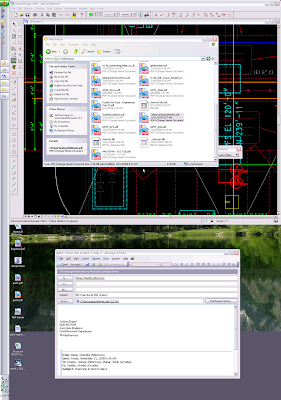
rdesktop is pretty cool. Check out an rdp session between a machine running Ubuntu remoting to a windows box. rdesktop is using both monitors for the remote windows desktop. Pics below:
I work for a company that uses and Active Directory domain for the internal network. Therefore, kerberos authentication is supported. MacOS also supports kerberos authentication, so I can replicate most of the single sign-on experience on my Mac. I wrote a simple shell script to get a kerberos ticket-granting ticket and mount the network drives: #! /bin/bash # get the local IP address theIP = ` /sbin/ifconfig | /usr/bin/grep "inet 10" | /usr/bin/grep -v inet6 | /usr/bin/cut -d " " -f2 | /usr/bin/cut -d . -f1` # if IP address starts with 10 then I am probably on work's internal network if [ $theIP -eq 10 ] ; then /usr/bin/kinit -f --enterprise --canonicalize username@company . com@COMPANY . COM /usr/bin/open 'smb://server.company.com/share' fi To make this script really useful, I save my password securely in MacOS's keychain so that kinit can grab it automatically. I use the following command in the terminal: ...
I don't know about the rest of you, but the Finder on Snow Leopard is extremely slow for me. I was seriously considering downgrading to Leopard, but the exchange support keeps me on Snow Leopard. As I was browsing the forums, I found a post that mentioned Path Finder . I had forgotten about Path Finder. I tried it back when I was using Tiger, but it seemed overkill for my needs. My frustrations with the current Finder led me to give it another try. Oh my goodness! Finally, quick, efficient file browsing! Even network shares are extremely fast. For anyone suffering with Snow Leopard's Finder, give Path Finder from CocoaTech a try. It makes my Mac a joy to use again. For all the KDE users out there, all the nifty utilities and features of Path Finder make me think of the konqueror file browser. It includes dual-pane browsing, tabs, a terminal drawer that opens to the current directory, recent folders/documents list, and more. Check it out if you have time. Once nice ...
I recently erased my hard drive and reinstalled macOS High Sierra. I had previously made a Time Machine backup and wanted to bring in my old email into Mail.app. In prior versions of macOS, I just had to copy the Mail folder into ~/Library, but that did not work in High Sierra. Mail told me that it could not convert my mail to the new format. I then tried the import option and pointed to the specific mailbox in Time Machine, but that made all kinds of subfolders that were difficult to deal with. Finally, I decided to copy all the .emlx files to the same folder, rename the folder with an .mbox extension and try importing them. Yeah! This worked very well. In terminal, I navigated to the Time Machine folder for ~/Library/Mail and then drilled down until I got to the Data directory of the mailbox with the messages I wanted. Then I ran the following command to copy them to a folder on my desktop called mailbox.mbox: find . -name '*.emlx' -exec cp...


Comments